
The website is currently under maintenance on Saturday, October 24th. Thank you for your patience.
Heart-Centered Therapy
A Compassionate Space to Explore What's Beneath the Surface
Sometimes you know something isn't working, but you're not sure why it keeps happening—or how to change it.
You may notice the same emotions, reactions, relationship patterns, or beliefs showing up again and again. You may know what you want to do differently, yet find yourself responding in familiar ways.
Heart-Centered Therapy offers a gentle, one-on-one space to become curious about what's happening beneath the surface and explore what may be influencing how you feel and respond today.
You don't have to have it all figured out before you begin.

What Is Heart-Centered Therapy?
Heart-Centered Therapy (HCT), developed by Alaya Chikly, is a compassionate approach for exploring emotions, beliefs, past experiences, and recurring patterns.
Rather than judging, analyzing, or trying to fix what comes up, HCT invites curiosity and compassion.
A thought, emotion, belief, memory, or sensation may become an opportunity to listen more closely to yourself and recognize what may need attention.
For me, this fits naturally with the philosophy that guides all of my work:
Notice
What is showing up?
Reconnect
What am I feeling? What do I need? What matters to me?
Choose
What possibilities or choices are available to me now?
Notice • Reconnect • Choose
This Work May Be a Good Fit If...
You find yourself:
Repeating the same emotional or relationship patterns, even when you want something different
Reacting more strongly than you'd like and wondering why certain situations affect you so deeply
Knowing what you want to change but still feeling stuck in familiar ways of thinking, feeling, or responding
Struggling to express what you need or put yourself first without guilt, fear, or self-doubt
Carrying past experiences that still affect how you feel, relate, or respond today
Sometimes the first step isn't knowing why something is happening. It's simply noticing that it is.
When Emotions Contribute to Physical Pain
Our emotional experiences don't just affect how we feel—they can also affect how our bodies function.
When we experience stress, fear, grief, or other difficult emotions, our bodies respond. Muscles may tighten, breathing may change, and our nervous systems may remain on alert. When these responses continue over time, they can contribute to chronic tension, discomfort, and pain. Sometimes, even after addressing the physical symptoms, the pain returns because the stress or emotional patterns contributing to it haven't changed.
After more than three decades of working with the body, I've come to recognize the importance of exploring both the physical and emotional influences on pain. Heart-Centered Therapy offers a gentle way to explore emotions, memories, and beliefs that may be contributing to how your body feels and responds. As these patterns shift, your body may have greater opportunity to relax, regulate, and heal.
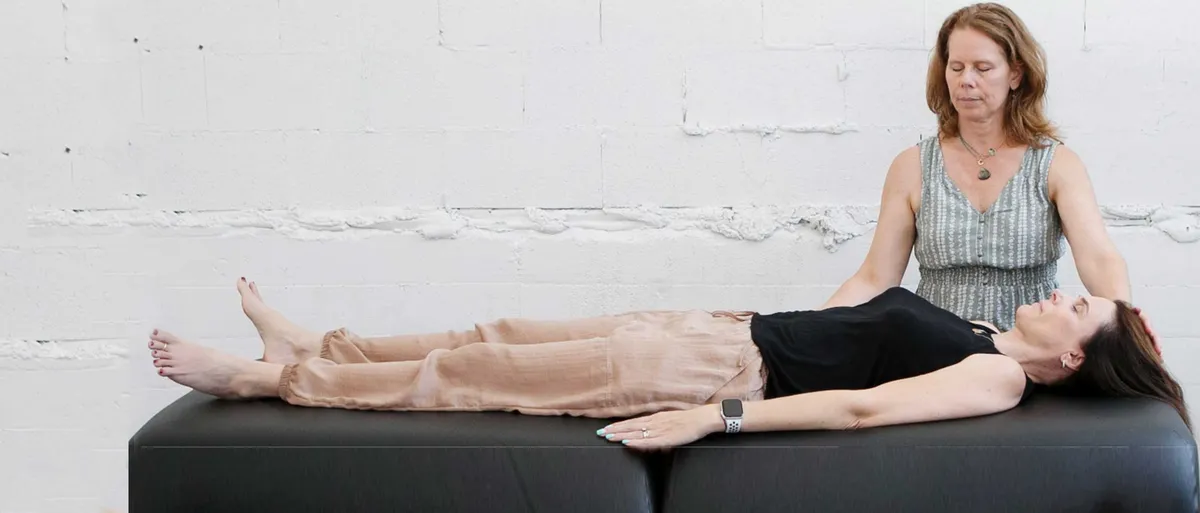
Heart-Centered Therapy can be experienced as a stand-alone session or, with your permission, incorporated into a bodywork session.
What to Expect
Your session begins with a conversation about what you'd like support changing. You may come with a specific situation, relationship, emotion, belief, or pattern—or simply a sense that something doesn't feel right.
We start the session with a positively stated intention such as 'To feel peaceful' or 'To feel loved' or 'To improve my relationship with...'
There's no expectation that you uncover something specific or go somewhere you aren't comfortable going. You can ask questions, provide feedback, pause, or choose not to explore something at any point.
This is collaborative work. Your comfort and choice matter throughout the session.
Heart-Centered Therapy & Bodywork
Sometimes the body brings something to our attention that isn't only physical.
During bodywork, you might become aware of emotions, memory, thought, or belief connected to what you're experiencing.
If that happens, we can simply notice it and continue with bodywork—or, if it feels appropriate and you would like to, we can use Heart-Centered Therapy to explore it further.
Nothing needs to be forced.
Sometimes listening to what arises is enough.
A Different Way of Relating to Yourself
One of the things I value most about Heart-Centered Therapy is the opportunity to approach ourselves differently.
Instead of:
What's wrong with me?
We can become curious:
What am I noticing?
What might this reaction or pattern be showing me?
What do I need?
Is this belief or response still supporting me today?
What choice do I have now?
You don't need to criticize yourself into changing. Sometimes change begins when you become curious enough to listen.
Client Experiences
“I had something specific I needed to talk to someone about. Kim provided me with a space which was safe enough to voice it.”
— Lori L.
“Kim has a capacity and the tools to assist people in seeing clearly from their heart. She’s a wonderful combination of warmth, intuition, and tremendous skill.”
— Jenny C.
“Every time I visit with Kim, I learn something new. Today I learned a tremendous amount about my inner child, and how to overcome fears in my adult life, so I'm able to better evolve onward and upward in my journey through life.”
— Glenn P.
Heart-Centered Therapy & (Re)Parenting Empowerment
There is a natural connection between Heart-Centered Therapy and my work through (Re)Parenting Empowerment, but they are different offerings.
Heart-Centered Therapy is individualized, one-on-one work that allows us to explore what is present for you personally. It can also be incorporated into bodywork.
(Re)Parenting Empowerment, which I co-founded with Meg Judge, offers retreats, courses, workshops, and professional trainings that explores how earlier experiences and learned patterns can influence how we relate to ourselves and others today.
Both invite us to become more aware of our patterns, meet ourselves with greater compassion, and recognize the choices available to us now.
Frequently Asked Questions
Do I need to know what I want to work on?
No. You may have something specific you'd like to explore, or you may simply know that you're feeling stuck or noticing a recurring pattern. We can begin with what you're experiencing now.
Is Heart-Centered Therapy only for emotional concerns?
No. HCT can be used to explore physical pain. It can also be incorporated into a bodywork session.
I'm not sure whether to book Bodywork or Heart-Centered Therapy. What should I choose?
If your primary concern is physical—such as pain, tension, headaches, an injury, or changes in how your body is functioning—Bodywork is usually a good place to begin.
If you'd like to focus primarily on emotions, beliefs, relationships, or recurring patterns, a Heart-Centered Therapy session may be a better fit.
Sometimes physical and emotional experiences overlap. You don't have to figure that out before you come in. We can begin with what you're noticing and decide together what kind of support makes the most sense.
Do I have to talk about my past?
No. Past experiences may come up, but there is no requirement to explore anything you don't want to. We work with what feels appropriate for you in the present.
Is Heart-Centered Therapy psychotherapy?
No. I am not providing psychotherapy or mental-health treatment. Heart-Centered Therapy does not replace care from a licensed mental-health or medical professionals.
Can I receive Heart-Centered Therapy remotely?
Yes. Because HCT is guided one-on-one work, sessions can also be offered remotely.
Can we combine HCT and bodywork in the same session?
Yes. I recommend scheduling a 90 minute session. Sometimes something emotional naturally becomes noticeable during bodywork. With your permission, we may incorporate HCT into the session. Other times, the session may remain entirely focused on physical bodywork. You always have a choice.
Ready to Begin?
You don't have to know exactly what's beneath a pattern before you begin. You don't have to have the right words.
And you don't have to figure it all out alone.
Start with what you're noticing.
From there, we can become curious about what you need and what choices may be available to you now.
Notice • Reconnect • Choose
Change Begins with One New Choice.
Kim's Email: [email protected]
Contact
Rivergrove Office Park: 2111 Front St. NE
Suite 2-201-E
(Building 2, Suite 201, Room E)
Salem, OR 97301
Kim's Mobile: 503-409-2772
Website & Educational Disclaimer
Information provided by 8 Hands Healing, Inc. through this website, classes, workshops, videos, free resources, emails, and other educational materials is intended for general educational and informational purposes.
Kim Holman is a Licensed Massage Therapist in the State of Oregon. Information provided through the website or educational offerings is not intended to provide a medical or mental health diagnosis or to replace individualized care from an appropriately qualified healthcare or mental health professional.
Massage and other one-on-one services are provided according to the nature of the service, Kim's training and professional scope, and the individual client's needs and consent. Results vary, and no specific outcome can be guaranteed.
If you have concerns about a medical or mental health condition, please consult an appropriately qualified healthcare professional.
© Copyright 2026 8 Hands Healing, Inc. All Rights Reserved.